

One Last Assist For Barry: New Soccer Coach Has Barry History
By Kymani Phillips
From teammate to coach, Juan Pablo "Juanpa" Correa is back at Barry University with a new perspective on soccer. The former Buccaneer shares how his journey from college to professional soccer shaped the lessons he now teaches his players.

It was just six short months ago that Juan Pablo “Juanpa” Correa was inside the Barry University locker room celebrating with his teammates.
Today, if he isn’t arranging the bus ride home, he can sometimes hear those same players celebrating from the other side of the door. The songs are familiar. The voices are familiar. The difference is that Correa no longer starts these chants. He is now one of the coaches responsible for helping create these unforgettable moments.
For Correa, 25 years old, returning to Barry as an assistant coach has brought him back to the university that changed how he viewed college soccer. More importantly, it has brought him back to a place where he can teach younger players a lesson he learned the hard way: soccer can shape your life without determining your worth.
Originally from Colombia, Correa moved to Argentina and developed as a soccer player there. By the time he arrived in Miami in 2022, soccer had always been viewed through one lens: to become a professional.
Growing up in South America, Correa confessed, college soccer was often seen as an alternative for players who did not make it professionally.
“College wasn’t so interesting to me because we have this mentality in Colombia or any place in South America that college was a way out when you didn’t make it pro,” Correa said.
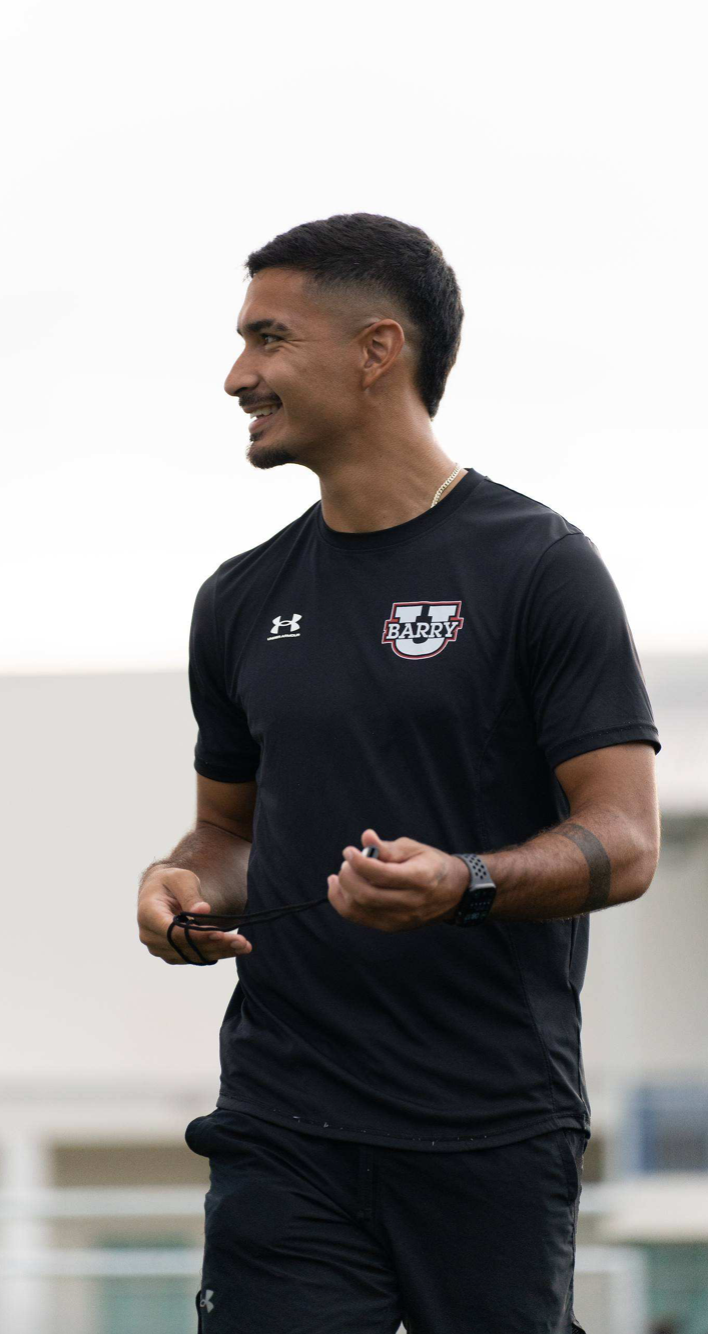
Barry helped change that belief. After two years with the Barry soccer program, Correa transferred to Florida International University, looking for more difficulty at the Division I level.
But FIU gave him something he had not experienced before: uncertainty. He was no longer guaranteed a starting position nor significant playing time. Correa confessed, “It was hard for me.”
Soon, things became clearer.
“I started to think that there’s way more things beyond soccer,” he said.
He returned to Barry to finish his college eligibility and later played professionally in Puerto Rico. The professional game changed his understanding of what separated good players from great ones.
College soccer could be physically demanding. At the professional level, he noticed how much importance was placed on technical details and decision-making.
“How you take a touch forward, how you take a touch backward,” Correa said. “How can you make this pass with your right foot so it’s comfortable for your teammate to receive the ball and continue his run?”
Playing under different coaches also gave him lessons he carries into his own coaching. He learned from what coaches did well and what he would do differently. Coaching was something Correa saw in his future, but not until years to come, he still wanted to continue playing professionally. When Barry’s head soccer coach Petsa Ivanovic, known as Coach Ivan, called with an opportunity, the decision became clear.
Correa returned to Barry, where some of his former teammates were now under his direction.
“It was challenging, having to create that line between being their coach now and no longer just their good friends,” Correa said.
The training room became one of the clearest reminders of that adjustment. He once went there to lift weights with his teammates. Now, he makes sure his players maintain the same discipline.
Coach Ivan's possession-based philosophy, building from the back, moving the ball and refusing to force a pass when an option is not available, remains influential in the way Correa sees the game.
However, his coaching extends beyond tactics. He wants his players to feel comfortable talking to him because he remembers how much a strong relationship with a coach can mean to a player.
Most of all, Correa wants his players to enjoy their time. College soccer goes quickly, he said, and a bad game should not overshadow the experience. Players should show up, compete and appreciate each practice because they will never get it back.
As a teen, Correa believed that failing to become a professional soccer player would make him a failure. Now, after everything soccer has given him, he sees success differently. He wants the players coming after him to understand that, too.
“If you make it or not, you’ll be okay,” Correa said frankly. “When I was 15, I believed if I didn’t make it pro, I would be deemed a failure, which should have never been the case.”



Comments